A Connoisseur’s Pilgrimage to Hawaii’s Pinnacle of Luxury
The trade winds carried a faint scent of plumeria as James stepped off the plane at Kahului Airport in early 2026. He was not a typical tourist chasing the next Instagrammable sunset, though Hawaii’s sunsets were undeniably spectacular. James was a connoisseur of the rarefied, a man who measured a destination by the thread count of its sheets and the discretion of its butlers. His mission was simple: to spend three weeks drifting through the most expensive and luxurious hotels the Hawaiian Islands had to offer, and in doing so, to rediscover the very meaning of paradise.
He started his journey on Oahu, specifically in the heart of Waikiki. There, towering above the glittering coastline, stood Espacio, The Jewel of Waikiki. It was more than a hotel; it was a statement. As James’s personal concierge unpacked his luggage, he gazed out at the ocean from his $4,500-per-night suite. Every surface shimmered, from the mother-of-pearl inlaid tables to the Japanese Toto toilets that greeted him with a warm, welcoming hum.
Espacio’s staff moved with a silent, choreographed grace, anticipating needs he hadn’t yet voiced. A snorkeling excursion off the beach was arranged within minutes, the equipment so pristine it seemed to have never touched water. Later, at the rooftop infinity pool, James sipped a lavender-infused champagne while the sun melted into the Pacific. The experience was less a hotel stay and more a profound immersion into a private, exquisitely maintained pocket of the world.
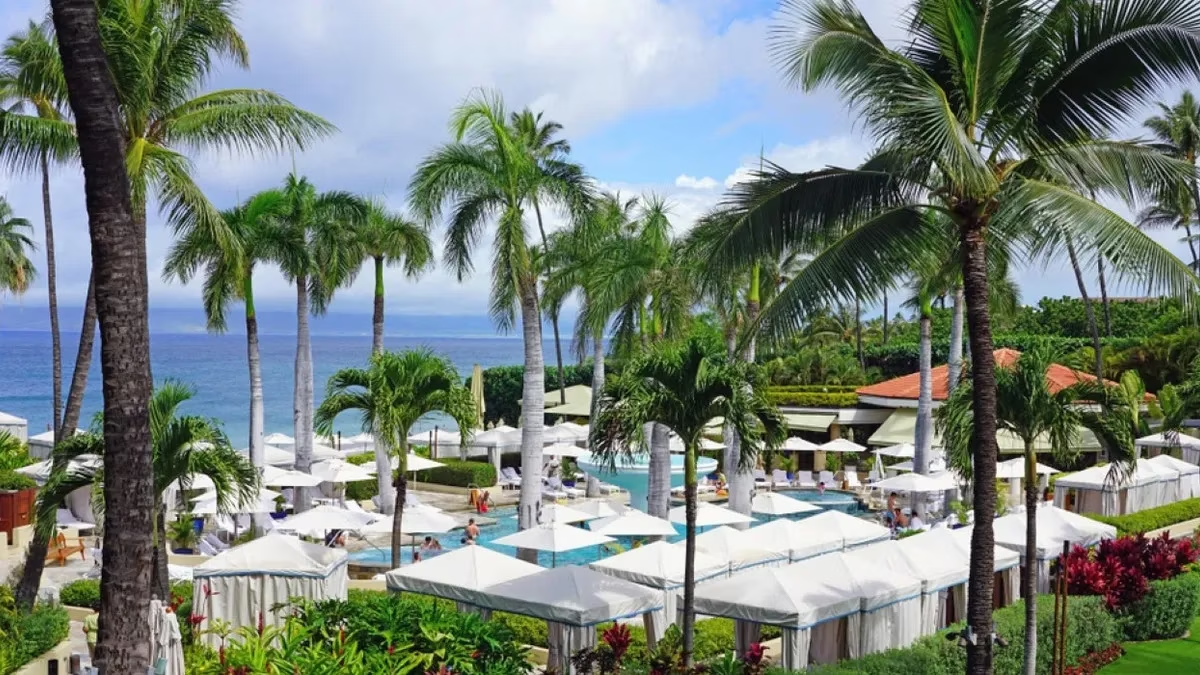
From Oahu, James island-hopped to Maui, his car weaving along the Honoapiʻilani Highway to the legendary Four Seasons Resort Maui at Wailea. The property unfurled like a botanical garden obsessed with proportion, with towering palms framing cascading outdoor pools. This was where luxury felt effortless and deeply intertwined with nature. James checked into a ground-floor suite that opened directly onto the manicured lawns leading to the adult infinity pool.
The resort’s water sport facilities were a siren call. James, an avid scuba diver, spent his mornings exploring the submerged volcanic crater of Molokini, arranged seamlessly by the hotel’s beach crew. Afternoons melted into the tranquil ritual of lounging by the adult-only serenity pool, a glass of local POG juice in hand, listening to the distant ukulele of a passing canoe. The Four Seasons was not merely a place to sleep; it was a masterclass in the aloha spirit wrapped in five-star indulgence.
A short drive north along the coast brought him to the Montage Kapalua Bay. Here, the atmosphere shifted from vibrant Wailea to a more secluded, exclusive calm. The very air felt rarefied. James’s residential-style suite, complete with a gourmet kitchen he would never use, overlooked the crescent-shaped Kapalua Beach, a mere ten-minute walk away. The resort felt like a private estate.
James, briefly embracing his athletic side, played a round at the Kapalua Golf Club Bay Course, a two-minute walk from his villa. The wind was a mischievous opponent, but the views of Molokai across the channel were a glorious consolation. Here, luxury was defined not by opulence but by the purity of the landscape and the space to breathe it in.
A few nights later, James settled into the Ho’olei at Grand Wailea, a property designed for companions. His three-bedroom villa was a sprawling temple of beige marble and dark wood, with a private elevator whisking him directly to the beach level. The most exhilarating amenity, however, was the network of water slides weaving through the resort’s pool complex.
He surrendered to the childlike joy of a twisting tube slide, emerging into a lazy river with a triumphant splash. It was a reminder that the grandest luxury sometimes included a license to play. The villa’s balcony, where he dined on seared ahi while the sky turned violet, was a crow’s nest from which to observe the Pacific’s vast, rhythmic power.
James’s Maui sojourn concluded at The Westin Maui Resort & Spa in Ka’anapali, followed by the historic Sheraton Maui Resort & Spa. At the Westin, the infinity pool blurred the line between chlorinated calm and the churning ocean beyond. James allocated an entire day to the Spa and Wellness Center, a multi-hour ritual of hot stones, Hawaiian lomi lomi massage, and steam rooms infused with eucalyptus. The scent alone was worth the room rate.
Not fifty yards away, the Sheraton Maui offered a different, equally storied charm. It was from here that the nightly cliff diving ceremony at Black Rock commenced each sunset. James watched from the bar of the Sheraton’s private beach, snorkeling gear dripping by his chair, having spent the hour before among the sea turtles that flocked to the lava rock. The service was cheerful, the rooms flawlessly comfortable, and the sense of place was absolute.
Crossing the channel to Kaua’i, James checked into the Grand Hyatt Kauai Resort and Spa, a sprawling monument to tropical abundance. The property was an ecosystem in itself, threaded with navigable waterways and a saltwater lagoon hosting over a hundred species. His room, perched on a hillside, offered a vista of the Shipwreck Beach coastline. The real sanctuary, though, was the Anara Spa.
Within its open-air treatment rooms, James surrendered to a volcanic ash body wrap as tropical birds provided the soundtrack. The sauna and steam room were a daily pilgrimage. Here, on the Garden Isle, luxury was organic, healing, and deeply rooted in the land. The resort’s water slide, a serpentine coil dropping into a lush pool, provided the requisite adrenaline spike before dinner at Tidepools, where koi fish swam beneath his over-water bungalow table.
The final, most transcendent chapter unfolded on the tiny island of Lanai. Transportation was a private charter flight, arranged with unnerving precision by the Sensei Lanai, a Four Seasons Resort. Nestled in the misty uplands, this was not a beach resort. It was a wellness enclave where luxury was minimalistic, intellectual, and profoundly restorative. James’s room was a study in Japanese-inspired restraint, with clean lines and a private garden soaking tub.
An on-site nutritionist designed his meals, his body was mapped by a team of wellness experts, and his afternoons were spent in the sprawling outdoor yoga pavilions. A 20-minute walk took him to the Lanai Culture and Heritage Center, a poignant counterpoint to the futuristic wellness tech. Sensei Lanai recalibrated his sense of what a luxury retreat could be—less about satin and more about the soul.
As James flew back to Honolulu for his final night at The Ritz-Carlton Residences, Waikiki Beach, he reflected on the odyssey. The Ritz-Carlton was the urban counterpunch, a sky-high aerie with panoramic views of the Waikiki Shopping Plaza and the Royal Hawaiian Center just steps away. His suite was a magnificent living museum of fine art and technology, where the infinity pool seemed to spill into the city’s glittering grid.
Dining at the Ritz-Carlton’s rooftop restaurant, with the Diamond Head crater looming in the twilight, James realized that Hawaii’s most expensive hotels were not simply price tags. They were distinct portals into different fantasies of the islands: the ultra-indulgent suite, the nature-immersed resort, the playful family villa, and the serene wellness sanctuary. Each, in its own flawless way, offered the greatest luxury of all—a perfect, temporary escape from the known world. In 2026, Hawaii’s ultimate indulgence isn’t just a room; it’s the curated dream you choose to live within it.